Friday, March 16, 2012

Reply to Arina T's post "Lara Croft: Cyber Heroine"


As her title suggests, Arina's post dealt primarily with the Tomb Raider series legend Lara Croft. She raised many interesting points from a female perspective of this video game character, points which I would never really consider as a male. While I enjoyed the commentary she provided, my reply to her has to deal with a comment she made slightly unrelated to the topic of her post.

Arina stated, "I believe that (video games) serve a very grand purpose in the development of certain skills if played moderately. These games allow children to experience the world without actually physically doing so; they get to travel to different parts of the world and get put into not so ordinary situations." Simply put, I couldn't agree more.

I grew up as an avid video gamer. There has been a video game console in my house since the day I was born. As such, I have played countless hours of various genres of video games. For me at least, I have used video games to do exactly what Arina described above - experience the world. Those who are opposed to children playing video games often don't see this perpective of gamers - the perspective of an explorer, of a learner.

The slogan above was the slogan for Sony's Playstation for many years, and was the slogan when I got my first Playstation console. It is a slogan that I didn't put much thought into then, but in perspective to the discussion now, it applies so much more.

The purchasing of a new video game is equivalent in a way to receiving an invitation to enter into a new world. A parallel can be drawn between those who just bought the game and the character that they are given at the beginning of their new game. These beginner characters are unaware and unable to utilize the potential they possess; instead they must go through multiple challenging levels that will help them gain the necessary skills and abilities to unlock their potential and to complete the game.
While these beginner characters grow, so to do those who are playing the game. The character would not be able to develop were it not for the input of the gamer. This to me shows the real value of a video game.


Video games have always taken criticism for offering nothing to those who play it, these critics often feel that video games make your brain go to mush and cause your social skills to disappear. What these critics don't realize is that video games are designed to challenge our brain in ways that the real world could not adequately do so. As EA Games has stated in their slogan for years, they want video gamers to "Challenge Everything." Video games make us use logic, memorization and quick thinking to progress through levels. Video games encourage us to not accept the norms of society that are forced upon us. By challenging that which is usually assumed to be fact, we can grow both within the game and as human beings.

Socially, video games have always been an avenue for friends to get together and have a good time together. Before there was online gaming there was still multiplayer gaming. I remember the days when all my friends would come over and we would play hours of Goldeneye or Perfect Dark on my Nintendo 64. Now that online capabilities have been introduced we still get together, just in a virtual meeting room. I have met a lot of new friends thanks to online video games, and I have made friendships I already have stronger thanks to the video games we play together.

Video games are simply a cultural phenomenon of the current generation. Kids used to go to arcades to play these games and to socialize, technology has made it simpler for the new generation to do what arcades did for past generations. Every generation is going to blame the one before for differences, what all generations need to realize is that there is not much of a difference between them - the only thing different is our environment.

Blog post I am replying to:
http://wordofmouse999.blogspot.ca/2012/03/lara-croft-cyber-heroine.html

Tuesday, March 13, 2012

Reply to Andreia D's post "Spartacus, Gladiators and Gods"

“Even the lowest man can rise above the heavens.” What a powerful quote. I am glad Andreia decided to use this quote in her article in which she suggests that athletes see themselves as the 'lowest man' and it is their goal to 'rise above the heavens' or win in sports terms. I agree with her application of the quote and I can understand her viewpoint in terms of athletes risking a lot when they enter into a game. However, I disagree with the notion that these athletes or the sports in general should be scrutinized.

Andreia only focuses on primarily the combative aspect of sports. Meaning those sports in which players act out violently towards one another with the intention to injure. While no one should ever condone the injuring of others, and that is not at all what I am going to be doing here, no one should ever judge these athletes which partake in sport due to their willingness to risk life and limb to bring their team a championship.

When I first read the quote Andreia chose to use from Spartacus, I was not immediately thinking of athletes fighting each other and injuring each other. Instead I was thinking of the notion that athletes will do whatever it takes to win. This may seem like a foreign concept to many, but for a professional athlete the sport they play is often their life. It is what they live for, it is how they make their living. They know that they are risking injury, but they also know that their bodies can be pushed further than any other human being on the planet. They are willing to take some short term pain in return for the long-term elation from winning. For example: Curt Schilling, a pitcher for the Boston Red Sox, tore a tendon in his foot prior to the 2004 World Series Playoffs. He refused to miss the playoffs, so he had an experimental procedure done where the tendon was stitched in place. During one performance, the stitches tore open causing his sock to become bloody. He pitched through the pain and ended up being an integral piece to the first World Series win for the Boston Red Sox in 80 years.

There are many ways in which an athlete can get injured, and they often are as the result of strenuous activity not from bodily contact. Athletes will push their bodies to limits that non-athletes simply would not think of. There are many athletes who will play through an injury because they know that they can handle the minor pain. Watch any sports talk show after a sports playoffs end and you will likely see them talking about the list of players who played through various injuries, some of which who will be requiring surgery. You can argue that the majority of them did not come out victorious, but the fact is they gave it their all to at least try and win. Any athlete will tell you that they would rather know that they gave it their all and lost over not having tried at all.

This concept of playing through injury was showcased in Season 11 Episode 11 of The Simpsons in the episode entitled "Faith Off". There is a scene in this episode where Homer runs over Springfield University's star kicker at the football homecoming game. To solve the issue Homer gets Bart (who is a Faith Healer in this episode) to heal the kickers leg (Bart really just wraps the kickers leg in tape). The kicker goes on to kick the game winning field goal, but while kicking his lower leg detaches from the rest of his body and is seen flying through the air and kicking the football a second time as it starts to dip. The field goal is good and Springfield University wins. While this is a satirical take on the concept of athletes doing whatever it takes to win, including playing through injury, it is still an effective example of what my point was above.


Blog Post I am replying to: http://smc305ohmyblog.blogspot.ca/2012/03/spartacus-gladiators-and-gods.html

Tuesday, March 6, 2012

Reply to Sandra's post "Making Good Deeds Public"|

When I read the quote at the beginning of Sandra's article, I immediately thought of the concept called "Pay It Forward". Pay It Forward is a concept that was made famous in a book and later movie both released in 2000, however it was created centuries earlier. The premise of Pay It Forward is pretty simple: If you perform a good deed on another person, instead of that person repaying you they are to turn around and perform three good deeds for whomever they choose. The idea is to make the lives of those around you better which will in turn make your own life better.

This concept of Pay It Forward is one that has always stuck with me ever since I first was made aware of it. This is not to say that I am some perpetual good samaritan that goes around doing endless good deeds for those I do not know, but I do at the very least try and offer a helping hand whenever I am able to. I do this simply because I am of the mindset that I would hope if I were in the same position of those I help, they would step in and offer a helping hand to me also.

In Sandra's article, her argument centers around the fact that celebrities are often seen in the public eye doing varying charitable acts or good deeds. They are not just being caught candidly doing these acts, they are often paying for the publicity they receive so that they can broadcast to the world that they are giving back as if it was their duty. I see this as being the opposite of what the above Pay It Forward concept is trying to accomplish.

Don't get me wrong, the money that these celebrities raise for whatever charity it is that they are supporting is surely welcomed funding for those charities. And I am sure that this funding does to a degree go towards individuals who could really use some help. However, charities really only cover the specific areas that they cover. Not everyone who is in need of help is looking for monetary support. Sometimes someone who is extremely well off still needs a helping hand, or a shoulder to cry on, or someone to talk to.

It is important to never judge a book by its cover. Everybody has something in their lives that they need help with. They may be too proud to show it, but nobody is perfect. In fact those that have read this probably immediately related it to an issue somewhere in their own life that they wish they had some help or support with. I know I did as I wrote it. My point is, the act of making good deeds public is unnecessary, and should not be why someone helps another person. You do not help others because you want to come off as a better human being, because when all is said and done you're still only helping yourself.

Friday, March 2, 2012

Using Christian Themes in Music - Creed

Creed is a band that rose to fame in the late 1990's and remained popular for much of the early 2000's. They released 3 multi-platinum albums in that time and have been ranked as the ninth best selling band of the 2000's. They have many hits with Christian-themed messages in them such as With Arms Wide Open, Higher, My Sacrifice, and One Last Breath. The band is named after the Christian concept of a creed which can loosely be defined as a system of Christian belief. With all of this in mind, it must be assumed that Creed is considered to be a Christian-Rock band right? Wrong.

While much of Creed's music is based on Christian themes, they have never been signed to a Christian-Rock label nor have they been embraced in the Christian community. This is for good reason. There is much controversy that surrounds Creed. Their lead singer, Scott Stapp, has a history of drug and alcohol abuse and has been arrested on multiple occasions. In 2003, Stapp was on the verge of suicide after a drug and alcohol induced panic attack, he wanted to go out like a martyr to boost sales of his bands records, just like Kurt Cobain did a decade earlier. Creed's problems eventually led to the bands break up in 2004.

We learned in this past weeks readings of 3 models of Christian themed lyrics in music as proposed by Brian Shills: Separationist, Integrationist, and Transformationist. Despite the adversity and lack of recognition that Creed experienced as a band, it can still be argued that Creed was very much an Integrationist Christian band. They used Christian themes in their music while still sticking to the popular music model to try and advance their sales.

Creed doesn't claim to be a Christian group but Stapp is an admitted Christian whom believes heavily in the faith. Above is a tattoo Stapp got on his arm in the late nineties signifying his faith as well as his bands importance in his life. Stapp was the primary lyricist in all the songs which have a heavy Christian undertone, and he states that they are meant to be seen as metaphors of situations he was having in his life at that point in time. Creed never wanted to be labeled as a Christian-rock band as they did not want to limit their music. It was just at that point in time that they were using Christian themes in their lyrics.

Their music was well received despite their internal controversies, this can be evidenced by their record sales and multi-platinum albums as stated above. However, there always seemed to be a ridiculing body saying something negative about the band. This was due in large part to the fact that part of the public had an issue in fully accepting a band with such religious undertones into the main stream.

I have personally always liked Creed, their music has gotten me through some tough times in my life and will always be something I remember. Christian theme or not, their music does portray a message to the listener. This message is different for everyone, and this I feel was Stapp's point when he stated that their music, despite the Christian themes, was meant to be seen as a metaphor his own personal struggles. I leave you with my favourite song by Creed - My Sacrifice.

Wednesday, February 29, 2012

Reply to Felicia P's post "Is This Guy For Real? - Tim Tebow"

Is Tim Tebow for real? Yes, yes he is.

I don't understand why everyone has made such a big deal about Tim Tebow's apparent belief in the Christian faith. Religion is nothing new to sports, and praising the heavens or God or whomever an athlete feels like praising after a great feat is nothing new. Tim Tebow is doing something that has been done in every sport for decades, he is thanking a greater power for his ability.

I am a baseball nut, I live for the sport. I have been watching since I can remember and have been playing since I was 4 years old. If you want an example of players praising a greater power after an exceptional performance or showing of skill, you should look no further than baseball. Have a look at the following photos:


These are just an example of the countless number of players that do a salute to above EVERY GAME. This has become so common practice in baseball that most don't even realize that the players are doing it. It seems like their routine, as if it is in their natural movement to do it. In a way, it is.

Baseball is a sport that is huge on superstition. A player often tries to repeat the same cycle of movements every time they take the field because they feel that if they were to change something then the baseball "Gods" would cast bad luck on them. For players that point to the sky, it is just as much a part of their routine as it is a showing of their faith. There is really nothing different between what they do and what Tim Tebow does after a touchdown pass. It can be argued that Tebow is just as superstitious as baseball players, because by nature athletes of all sports are superstitious. The only difference between Tebow and countless baseball players is that amount of coverage Tebow gets for something that really is not that big of a deal.

If anything, the fact that Tebow has a background that is heavily involved in his Christian faith should be applauded. It shows that he has reason to take a knee and pray. For baseball players, superstition may trump faith. They may be pointing to heaven for the simple reasoning that if it worked one time, they should keep doing it.

The thought of mixing Christianity into Popular Culture, in this case professional sports such as Football and Baseball, appears to yet again have raised an issue that has been so blown out of proportion that it is ridiculous. Who is anyone to judge another for their actions. Professional athletes may be in the public eye, and sure their actions should be critiqued, but only if these actions harm someone or something.

When a baseball player points to the sky after a homerun, a hit, a strikeout, or tying their laces they are not harming anyone, and the media does not go on a frenzy. Tim Tebow praying after a touchdown is just as harmless, let him do his job and if he chooses to pray it is his choice.

Article I am replying to:

Sunday, February 19, 2012

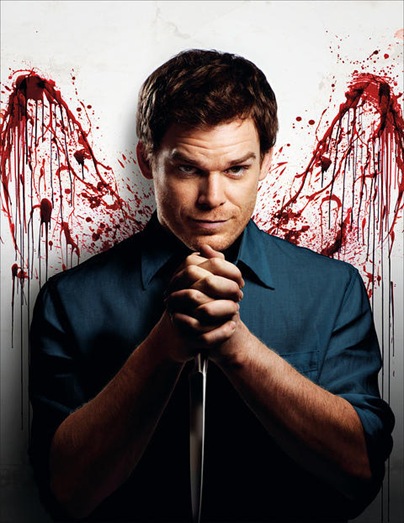
Dexter: A Murderous Angel?

I'll admit, I like TV just as much as the next guy. I grew up watching countless hours of various shows, some of which I don't remember and others which I'll never forget. I would watch every genre of show you can think of from teenage soap opera's to wrestling. I had my favorite shows and I had the ones I avoided, but overall there were always 5-10 shows I would have to watch religiously. I tended to stay away from shows that dealt with major religious undertones such as 'Touched by an Angel' or '7th Heaven', and generally avoided most of the reality shows that dealt with various religious issues such as '19 and Counting'. Looking back I guess it could be concluded that when it came to my television experience, I didn't want to give any religiously themed shows a chance.

Today I don't watch as much television as I used to due to various reasons and excuses, but I do still have a few shows that I keep track of weekly. These are Jersey Shore (don't judge me), True Blood, Entourage, and most important of all, Dexter. As you can see, I still don't follow any shows that have religion as a major factor in their storyline. That is until Season 6 of Dexter came along. It all started with this trailer:


When I first saw this trailer it was apparent to me that Dexter was obviously going to be taking a religious spin in the upcoming season. You see, Dexter is a show about a man who works for the Miami Dade County Police Department as a Blood Spatter Analyst. He is a pretty boring guy overall, aside from the fact that he is secretly a serial killer. It is exactly what I would consider a perfect show for me, it has action, thrill, blood, and a superb storyline. The underlying theme for each season is that there is a serial killer which Dexter eventually catches and kills, but not before learning something important about himself in the process. As can be seen from the trailer, the theme was going to incorporate religion into the mix for this season.

This seemed like an odd concept to me. The trailer was leaning towards the notion that Dexter could be viewed as a Christ-like figure in the series, that what he did was for a greater cause. Out of all television series, this was the last series which I thought would adopt Christianity into the storyline. After all, Dexter murders people. This act in itself goes against one of the 10 Commandments (Thou shall not kill) and on top of that, the series for the first 5 seasons had prided itself on the notion that Dexter followed his own religion which was taught to him by his father and which embraced the killing of people if it was viewed that they deserved it.

Needless to say, I was pleasantly surprised when Season 6 became arguably my favourite season of the series when all was said and done. The storyline was so well incorporated with Christianity, and it helped play on one of the most common mistakes in Christianity which is taking the bible literally. It showed (granted in an extreme way) what could happen when faith and the bible are used as an excuse to advance your own beliefs. Dexter also faced a dilemma throughout the season as to whether or not his own religion was not the right religion, due to the fact that his son was reaching an age where Dexter had to decide if religion should be a part of his life.

Seeing as the subject of our course is Christianity and Popular Culture, I feel that Season 6 of Dexter is a prime example of how eventually religion is tied into most forms of popular culture. As I said in a previous post, it is like adding Christianity (or a christ-like figure) to a show (or movie) is part of a fool-proof method to make a good product for the viewers. It might be frowned upon by some that Christianity is abused in such a way, but in another way it opens up the minds of those who are not as welcoming to the thought of Christianity in their popular culture (in this case a television show). I know personally, if Dexter was able to incorporate Christianity so well, then maybe I will start to give other shows a chance when I hear that they have Christianity entwined in them.

Sunday, February 12, 2012

Reply to Adrian D's post "Anakin Skywalker - Jesus of Star Wars"

I have to agree with how you viewed Anakin's role as a Jesus figure in Star Wars, Adrian. I too watched Star Wars on Friday night, however unlike you I am not a fan of the franchise. This was my first time ever watching Star Wars so I had no pre-conceived notions for how to view any of the characters, and once the film was finished it was apparent to me that George Lucas did go for the role of Anakin Skywalker as a Jesus figure in 'Star Wars Episode 1: The Phantom Menace'.

As I was leaving the theatre it was already clicking in my mind all the ways that Anakin had fulfilled the role of a Jesus figure in this film, and this was largely because of the lecture we had this past week. Your application of Kozlovic's 25 Characteristics of Christ Figures to Anakin solidified my view of Anakin as a Jesus figure. As I recall, Anakin is also referred to as "The Chosen One" multiple times throughout the film. "The Chosen One" is a line that is commonly heard in many other films that also choose to go down the Jesus figure, or saviour, route.

A common example of this can be found in the film clip we viewed in lecture this week, The Matrix. The Matrix uses a Jesus figure of their own, Neo, to advance their storyline. Neo is referred to multiple times as "The One". I feel like this concept of using a Jesus figure in a film is a lot more prevalent than I initially thought. I have always noticed that films have a character in a saviour role in them that often follow the same general path, but I never really had a name or concept to apply to this way of viewing a film. With the aid of Kozlovic's characteristics I can now identify and analyze these characters for what their actual purpose is.

Something I notice now that I think about these films with a Jesus figure in them, they appear to do really well in the box office as well as in the critics chair. The Matrix and Star Wars are prime examples of this. It appears that everyone loves a good plot where a saviour is necessary to save mankind. It is almost as if Kozlovic's characteristics are a basic guide to creating the main character in a blockbuster film. Everybody loves a hero.


http://tebowmania316.blogspot.com/2012/02/anakin-skywalker-jesus-of-star-wars.html